
The abrupt and stark decrease in traditional funding has severely impacted communities but has also left civil society organisations reeling from its consequences on operational and strategic matters. In response to the turmoil, the International Civil Society Centre has been researching alternative financing models and their implementation to foster organisational sustainability. After months of exchanges with our partners on their response to funding challenges, we convened a workshop to delve into the impact of alternative financing to strengthen organisational capacity and accelerate localisation efforts. We brought together a curated group of national and international civil society organisations (ICSOs), innovators, and funders to share experiences, models, and challenges. We debated and assessed how different models, among which: impact investment, membership models and social entrepreneurship, can help organisations continue delivering their mission and invest in their programmes while gradually reducing dependency on donor-driven models.
Alternative funding approaches not only fund (I) CSOs’ operations but also strengthen local economies when truly aiming to support the co-design of solutions to social and economic challenges. As the sector finds itself at a crossroads, embracing innovative and sustainable ways to fund programmes, beyond public funding and traditional donation cycles has emerged as a pivotal solution. But while income diversification has risen to the top of every organisation’s agenda, there are still significant hindrances to the efforts in engaging with new business models. Alternative business models often engage communities directly, fostering opportunities for co-ownership; however, local CSOs continuously face barriers to accessing alternative finance due to limited visibility and compliance-related red tape.
The case for alternative funding models and localisation doesn’t just require technical know-how but also an organisational cultural shift
In parallel to the exacerbation of funding challenges, the calls for localisation have become stronger in a time where civil society acknowledged that the standard operational models are no longer fit for purpose. International civil society organisations that are walking the talk in committing to the transition from implementers to enablers of local leadership play a key role in supporting local CSOs, helping to increase their visibility with funders and Global North governments. The International NGO BRAC evidenced how serving as ‘risk sinks’ for investors, therefore absorbing and managing risks on behalf of smaller partner organisations, had a significant impact on their partnership practices. Changing roles, however, requires internal transformation, cultural shifts, and the rethinking of success metrics. In fact, while many international CSOs are committed to strengthening their localisation efforts, often such commitments are not anchored in organisational mindset shifts, hindering progress. While the argument for localisation is widespread across the sector, meaningful progress is curbed by power imbalances and risk-aversion.
Adopting alternative funding models incentivises (I) CSOs to become not only financially sustainable but also to bolster innovation and build on their capacity to anticipate and prepare for future challenges. Furthermore, it provides organisations with the space to allocate resources to the provision of basic needs, rather than engaging in prioritisation exercises that risk inefficiency and creating additional gaps. As (I) CSOs are repositioning themselves in the civil society ecosystem, through decentralisation and the adaptation of partnership models, the discussion on their evolving roles should not be divorced from the timely review of their financing models. But how might the sector enable the conditions for new financial models to be trialled?
While many international CSOs are committed to strengthening their localisation efforts, often such commitments are not anchored in organisational mindset shifts, hindering progress.
Could the future of civil society financing lie at the intersection of social impact and market value?
Civil society organisations that took the leap in testing alternative funding models not only improved their organisational sustainability but also strengthened their ability to strategise for long-term, broader solutions, in a sector where financial resilience has become essential, given the precarious position of public funding. Alongside increased global solidarity and development of new narratives for civil society values, funding will be paramount to address the blockages that exist to localisation and power shift. The adoption of alternative models is further challenged by the limited evidence and literature around the testing and piloting of innovative financing models and the understanding of the intersection of social impact and market value.
During the convening with our partners, we examined which difficulties organisations face, but also which opportunities arise in these challenging times. Participants signalled concerns in exploring the limitations of applying an ROI (return on investment) logic to advocacy and human rights work. These debates have always elicited concerns across civil society, recalling the pressure to operate like commercial companies. Can we be imaginative in setting the foundations for organisations to produce community-defined value while operating as social businesses? The leveraging of private investments also emerged as a sticking point for several organisations, who are wary of the risks that come with such partnerships without adequate safeguards around governance and a clear overview of trade-offs.
The discussions among participants further encompassed the following insights:
- To adapt to the new funding landscape, CSOs need to rethink how they share resources and co-develop frameworks for collaboration and partnerships, particularly around infrastructure and support services.
- Focusing on domestic funding ecosystems can help identify new potential sources of funding by mapping national funding landscapes. To support this, building national-level funding mechanisms and encouraging domestic philanthropy is crucial.
- To test new financing models, capacity building needs to go beyond project management and include financial skills, risk management, and support for building partnerships. Measurement frameworks for non-financial outcomes, such as social return, inclusion, and participation, are becoming increasingly relevant for accountability and future funding.
- Regulatory frameworks often limit fostering innovation in civil society financing and some international CSOs are working with donors to change funding arrangements so that local partners can build long-term sustainability. Advocacy for financing reform is needed, particularly around investment rules for non-profits.
- Power and trust remain the core barriers in both localisation and alternative financing. Technical solutions, such as pooled funds, only work when there is fair governance, and this requires transferring decision-making power to the affected communities.
An effective and adaptive response response to navigating the sector crisis should be driven by innovation, not just by efforts to bridge funding gaps.
The transition to innovative financial models can only happen through a gradual transformation that challenges internal resistance and operational and fiscal pressure. The Centre has established a Working Group with the aim of co-developing a white paper outlining practical pathways to foster localisation while strengthening the capacities and financial resilience of organisations facing the sector’s financial crisis. This peer learning and evidence gathering exercise further aims to provide CSOs of all sizes and contexts with opportunities to engage with donors and investors through strategic guidance. We look forward to continuing to engage with partners on these timely issues for the sector.
An effective and adaptive response to navigating the sector crisis should be driven by innovation and not just to bridge funding gaps. By piloting new models and gathering data evidence of the feasibility of such models, we can move the needle in scaling new and sustainable solutions.
Related Insights
-

Rethinking the future of civil society: Why localisation and alternative finance matter now
The development sector is at a crossroads.
-
Funding
-
Leave No One Behind
-
-
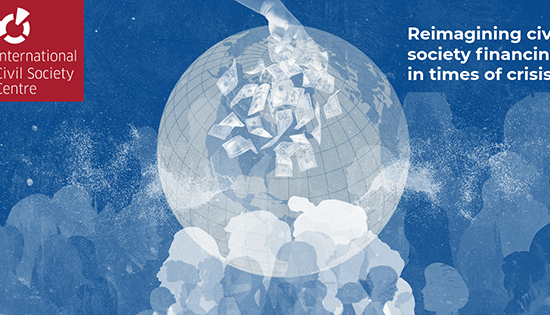
Reimagining civil society financing in times of crisis
This is the first blog post in a series authored by the...
-
Empowering communities
-
Empowering communities
-