

International civil society organisations (ICSOs) are increasingly seeking to redefine “post-aid” architecture to redefine locally led leadership and new financing models coming together. Organisations need to become responsive to changing priorities and seize emerging opportunities to build organisational capacity and foster resilience. A key aspect is to move away from centralised decision-making structures in power centres in the Global North to models that centre the communities they serve. The transformation towards more equitable and inclusive governance requires challenging leadership structures, funding models, and deeply held assumptions about the role and value that organisations have.
Taking time to reflect and strategise on the changes required is crucial, and in many fora these discussions are happening. This year we gathered in Livingstone, Zambia with our community and other like-minded organisations, for our Power Shift Lab, to explore how we can embrace change across strategy, advocacy and funding, while addressing the specific role that power shift can play in strengthening organisational dynamics and processes. In a time of unprecedented challenges for the sector, fora, where practitioners and leaders come together, play a key role in planting the seed for collaborative problem-solving, cultivating shared responsibility and the development of joint actions.
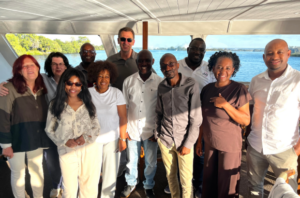
Participants at the Power Shift Lab 2026.
When rethinking power dynamics in our own organisational structures and governance set-ups, we see several themes emerging across the sector, which suggest possible actions and approaches that ICSOs can take to promote power shift and locally led development across their organisation. Among such approaches, organisations shall endeavour to rethink their mandate and added value to focus on co-creation with communities in meaningful ways and to explore their role as advocates for global solidarity and development effectiveness.
Shifting operational approaches.
Organisations are exploring structural changes to become more agile, effective, and anticipatory, while strengthening local participation and demonstrating the continued value of (I)CSOs. These approaches include transitioning to a network of networks, exploring mergers and collaborations, and sharing more power with local actors.
Some (I)CSOs have trialled merging staff functions, such as HR and finance, at country-office level, to strengthen operations, amplify their mission and ultimately foster shared systems. Others have focused on decentralising their decision-making structures while taking steps to transition into network models that increase participatory power and coordination, and develop organisational structures rooted in joint responsibility.
Organisations that won’t redefine their roles risk becoming irrelevant.
(I)CSOs are increasingly reassessing their roles, including positioning themselves as conveners, facilitators and connectors. Some organisations are exploring opportunities to move from top-down models to membership-based approaches and structures that more closely resemble social movements, to increase participation, efficiency, and organisational sustainability.
Real power shift happens when money is shifted.
Resources and finances are at the heart of governance and power shift-related challenges. Many organisations are holding discussions around how to mobilise funds for country chapters and at the local level. Among these, Wikimedia, for example, has been reassessing their revenue generation and distribution model to foster more equitable practices, while Plan International has sought to adapt its operating and funding models to different contexts, ensuring a shift of resources to local actors in more flexible ways.
Resourcing and financing became a key topic of discussion at our convenings, with the allocation and mobilisation of resources continuing to present a significant obstacle to meaningfully shifting power. As organisations rethink business models that rely heavily on grant-based funding and explore alternative approaches, local giving structures and community philanthropy have emerged as potential areas of exploration.