In today’s turbulent times, it can feel like a luxury to disentangle ourselves from immediate priorities and look ahead to what might be possible in the future. Yet this is far from a “nice-to-have”. For civil society organisations, stepping back to reflect on how we prepare for different, plausible futures is essential. Operating in an environment marked by shrinking civic space, political volatility, funding uncertainty, and rapidly evolving technologies, organisations are increasingly required to make long-term decisions under conditions of deep uncertainty. Without deliberately creating space to step back, reflect, and explore alternative futures, there is a real risk of becoming locked into reactive, short-term responses that limit adaptability and strategic agency. Foresight is therefore not a theoretical exercise. It helps organisations anticipate emerging risks and opportunities, stress-test existing strategies, and make informed choices today that strengthen resilience and relevance over time.
To explore what this means in practice, our Scanning the Horizon community of foresight strategists, organisational leaders, philanthropists, and development consultants engaged with different futures outlined in the Inter-Agency Research and Analysis Network’s Futures of Aid 2040 report. IARAN’s work examines how aid systems, actors, and practices might evolve over the next 15 years and what this could mean for civil society’s role, resilience, and impact. Grounded in a highly consultative process involving nearly 900 participants, predominantly from local and national organisations in Sub-Saharan Africa, Latin America, and Asia, the report centres the perspectives of those most directly affected by crises.
Rather than offering predictions, the Futures of Aid 2040 report provides a structured framework to examine key drivers shaping the aid landscape – from climate and ecosystemic breakdown to geopolitical realignments, technological shifts, funding volatility, and evolving humanitarian values. It develops a typology of crises and multiple scenarios that illustrate how different combinations of community resilience, destabilising forces, and aid system responses could lead to profoundly different outcomes.
But what does this mean for organisations making decisions today?
During the Scanning the Horizon meeting, participants immersed themselves in these scenarios. They explored how aid effectiveness might need to be redefined, which organisational capacities will matter most by 2040, and which types of crises feel most pressing – or most overlooked – in their own contexts. They also discussed early signals to monitor, and practical steps organisations can already take to strengthen preparedness. Key insights varied across the different scenarios but remained interconnected.
Participants highlighted the growing importance of empowering local actors through trust-based funding and new partnership models, even as civic space continues to shrink and financial support becomes more uncertain. They also reflected on the increasing politicisation of aid and the tensions this can create between effectiveness and core values, pointing to the need for organisations that are adaptable, diplomatically skilled, and able to navigate complex geopolitical pressures while maintaining integrity and strong alliances.
At the same time, discussions underscored the possibility of more fragile futures for civil society, raising questions about long-term resilience and emphasising the urgency of strengthening local networks, adopting needs-based and trust-driven approaches, preparing for increased displacement, and exploring more diverse funding sources, including private donations. Across these reflections, participants consistently emphasised localisation, flexibility, anticipatory capacity, and proactive strategic choices – not to predict the future, but to actively shape more resilient and equitable outcomes for civil society. A key takeaway was clear: organisations that build anticipatory capacity now will retain greater agency in the future.
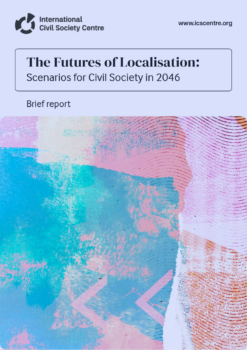
At the International Civil Society Centre, we have recently launched our own scenarios on localisation and civil society in 2046, using a participatory approach from our communities, including insights from regional and local CSOs in Africa, Asia and Latin America. Set against a rapidly changing and increasingly volatile environment for civil society, our scenario report explores plausible futures for the sector over the next 20 years, with a particular focus on power shifts, resourcing, and localisation. The scenarios are intended as practical tools to support reflection, strategic conversations, and action across the sector. You can read a brief of the report here and the full report outlining the methodology and findings can be found here. We look forward to continuing the journey of collaborative scenario immersion to aim for preferrable and possible futures. The question is not which scenario will unfold, but how prepared we as civil society organisations are to shape it.