
What is it, though, that has increased the turnover of executives in ICSOs over the past years, and has made it more complicated to succeed in the positions? This was the underlying question of a research project conducted by the Centre and Conner Advisory, who have interviewed Chief Executives in our ecosystem, over their patterns of success (or lack thereof), in their leadership positions.
In this first phase, we focused on simple dimensions. What are the internal factors that affect your success, what are the external challenges, and how does your leadership style and personality contribute to success in the job?
Success was defined by the interviewees themselves, and many focused on advancing internal organisational ambitions (like governance reforms, strategic plans, or transformational journeys) over the ambition to advance the mandate of their organisation. While external challenges to the civil society sector have clearly grown (through increased workload, political headwinds and resource constraints), many leaders managed to turn such crises into opportunities to make their NGO stronger. This confirms the general notion that crisis management is one of the strongpoints of civil society leaders, and that even the most demanding challenges can be turned into positive developments by them, if they are given the space.
What is striking, though, are the homemade complications that come with organisational governance (particularly in federated and confederated organisations), with difficult organisational cultures and with internal power dynamics, which exceed even the demands of leading corporate structures. It comes to no surprise that those leaders that have left their positions in frustration, attribute those to internal challenges that could not be overcome, including ethical dilemmas that arose from difficult organisational cultures, misdeeds and value gaps.
There are a few lessons to be learned from our observations that could help board chairs and the executives themselves to prepare for success.
- Assess as honestly as possible how well the leadership strengths (skills, experience, and predisposition) match the needs and (changing) circumstances of the prospective employer
- Establishing strong alignment between boards, power holders and the chief executive as early as possible in their tenure
- Be aware and actively manage ethical dilemmas (for the organisation as well as for the executive)
- When crises occur, be confident in their management abilities, but look for ways to leverage these crises to their (and the organisation’s) advantage
- Ensure that the chief executive surrounds him/herself with a team of competent leaders and other support mechanisms (e.g. strong deputy).
These are only a few recommendations that came out of the study. We acknowledge any shortcomings deriving from a small sample and have benchmarked our observations vs. other studies on the issue, linked below. We hope to continue our research to investigate other dimensions, like perspectives from the Global South and the perspectives of Governors on CEO success.
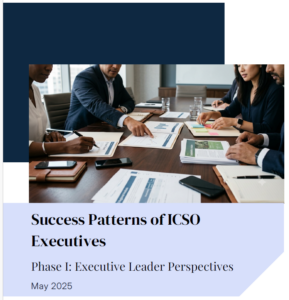
Download the report now: Success Patterns of ICSO Executives
Further reading from the referenced benchmarked studies:
“Understanding the Pathology of Large INGOs“
(Oliver Hudson and Mwikali Muthiani)
“Who do you think you are? The past, present, and future of international NGOs”
(Mike Aaronson and Michael Thompson)