
Opening Keynote
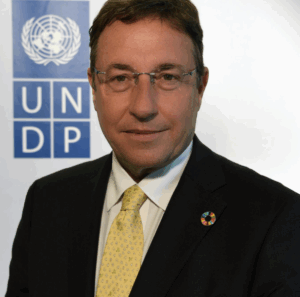 The opening keynote by Achim Steiner, UNDP Administrator (2017-2025) addressed civil society organisations and their role in the restoration of trust and hope for a better future, as a collective responsibility of the international community, particularly when it comes to the most vulnerable and marginalised groups.
Session 1: Civil Society at Cross Roads
Overview
In difficult times characterised by rapid change and increasing complexity, trust can be a glue that holds societies together. Having confidence in your community, in national and multinational institutions, and indeed in a prospective and safe future can counter the current tendencies for radicalisation and societal divisions. The restoration of trust and hope for a better future is a collective responsibility of the international community, particularly when it comes to the most vulnerable and marginalised groups.
In the current information landscape, it is more important than ever that CSOs join up innovative approaches to keep up with the tactics and techniques of malicious actors in the realm of disinformation and to seek solutions to mitigate the spread of misinformation, which often pollutes our information ecosystems and harms the work of CSOs.
A distinguished panel of civil society leaders will discuss, in how far we are at a crossroads, determining the credibility and legitimacy of civil society actors who work for social justice, inclusion and a fairer world. We will reflect on divisive and unifying trends in our societies, the changing role of civil society actors and the responsibilities that come with these new developments.
The panel
- (Facilitator) Wolfgang Jamann, Executive Director, International Civil Society Centre
- Abby Maxman, President, Oxfam America
- Astha Kapoor, Co-Founder and Director, The Aapti Institute
- Lance Pierce, CEO, NetHope
Watch the session now following the keynote address from UNDP Administrator, Achmin Steimer
Session 2 : Risk-sharing and Accountability for the Future of the Sector: Beyond Theory
Overview
This session addressed the challenges posed by anti-rights groups and their harmful narratives against progressive civil society and human rights. We moved beyond mere reactive responses, focusing instead on proactive, positive, and impactful narratives that reinforced the importance of human rights and civil society. We explored ways of building trust in civil society organisations and promoting truth over populist and harmful rhetoric. The session considered both global and local perspectives, recognising the need for different approaches across cultures and languages. We heard about concrete examples and learnings to help civil society actors effectively counter anti-rights actors and advance human rights.
The Panel
- (Facilitator) Antonia Potter Prentice, Director, Alliance2015
- Myriam Ciza Gambini, Project Manager, International Civil Society Centre
- Michael Vincent Mercado, Head of the Voice and Insights Lab, Center for Disaster Preparedness
- Phoebe So, Co-Lead, Fenomenal Funds
- Jan Bouwman, Partnership Broker in the Impact division, Oxfam GB
Session 3: Mental Health in the Digital Age: How are Civil Society Organisations using Technology to Advocate for Mental Well-Being?
Overview
Technology has become ubiquitous in our daily lives, especially for those living and working in cities around the world. The role of technology is now also entrenched in our working lives. While technology and social media platforms offer a way to connect and build communities, there is also another side to technology and social media use. Studies have shown that social media use can have detrimental effects on children and young people, particularly impacting their mental health and self-esteem. In the workplace, the predominance of tech use can lead to fatigue and burnout. Prolonged remote working during the pandemic took a toll on many employees, who still had to juggle daily responsibilities and challenges brought upon by the pandemic, including the risk of them or family members falling ill, job loss and income insecurity.
Panel
- (Facilitator) Rachel Wilkinson, Director of Programmes, International Civil Society Centre
- Emily Hewlett, Health Policy Analyst, OECD
- Duda Suzic, Chief of the Psychosocial Wellbeing Section, UN High Commissioner for Refugees (UNHCR)
- Christine Ombima, Executive Director and Founder, Stand Out 4 Mental Health
Session 4: Foresights and Insights on Mis-, Dis- and Malinformation: Using Futures Thinking Approaches for CSOs
Overview
In recent years we have witnessed a dramatic increase in the spread of misinformation and disinformation malinformation, particularly in the online ecosystem. This trend has been notably exacerbated in recent conflicts, wars and elections. Increasingly, it is harder to know what is real and what to trust. We are seeing the effects of this in the political sphere, our personal lives and in civil society.
This short session presented the significance of issues related to misinformation, disinformation, and malinformation for all civil society organisations (CSOs). It highlighted emerging trends and scenarios within the information ecosystem, illustrating their potential effects on CSOs and broader civil society.
Presenter:
- Rachel Wilkinson, Director of Programmes, International Civil Society Centre
Session 5: Building Effective Narratives to Counter Anti-Rights Groups and Foster Human Rights
Overview
This session focused on narrative-building as a crucial strategy to counteract the harmful narratives spread by anti-rights actors, which often threatened the progress of civil society organisations (CSOs) and their advocacy for human rights. Rather than simply reacting to these harmful narratives, participants explored how CSOs could take a proactive approach by crafting positive, impactful stories that challenged populist rhetoric and fostered greater trust and credibility in their work. The session examined both global and local perspectives, recognising the importance of tailoring narratives to specific cultural and regional contexts.
Panel
- (Facilitator) Ayesha Khan, Senior Research Fellow, ODI, Advancing Learning and Innovation on Gender Norms (ALiGN) platform
- Amina Hersi, Oxfam International, UK
- Rachel Litster–McQuibban, Project Manager Values-Based Messaging for Family Planning & SRHR, International Planned Parenthood Federation (IPPF)
- Mumbi Kanyogo, Strategic Communications Advisor, Kenya Comms Helps, Wellmade Strategy, Kenya (East African perspective)
- Mónica Roa, Puentes, Columbian, based in Madrid
Session 6: Can Citizen Data and Digital Approaches Foster Trust and Inclusion?
Overview:
In today’s rapidly advancing digital landscape, data and digital technologies are increasingly shaping how we address global challenges. While these advances offer great potential, they also risk leaving behind marginalised communities that lack access to digital tools and data. This growing “digital divide” limits the ability of these communities to benefit from technology-driven solutions and further widens disparities in areas such as education, healthcare, and economic opportunity. Without the availability of comprehensive data on these communities, gaps in public services and inclusion remain unaddressed, making it harder to achieve the global goal of “leaving no one behind” by 2030.
This session convened experts from different sectors to explore how digital tools and the use of algorithms in citizen data approaches can help to enhance trust and foster inclusion.
Panel
- (Facilitator) Aymann Akkad, Programme Officer Leave No One Behind, International Civil Society Centre
- Florence Syevuo, Executive Director, SDG Kenya Forum
- Saionara Reis, Senior Adviser and Team Leader, Data for Rights and Development, Danish Institute for Human Rights
- Joseph Hassine, Senior Manager of AI for Social Good, Google.org
Related events
Global Perspectives 2025: Towards a Thriving Civil Society in Times of Uncertainty
The Centre's annual flagship conference, Global Perspectives, took place from 18-20 November...

Global Perspectives 2023: Moments of Truth
Global Perspectives 2023: Moments of Truth, featured a series of open conversations...

Global Perspectives 2022: Transforming Civil Society Futures
Global Perspectives 2022 offered open and free online panel discussions with stakeholders...

Global Perspectives 2020: A Passion for Inclusion!
Global Perspectives 2020 took place for the first time online with a...
Global Perspectives 2021: Let’s Talk About Power
Global Perspectives 2021, focussed on the civil society sector approaches, opportunities and...