
We are all now operating in an environment shaped by rapid and overlapping change. Geopolitical tensions, climate shocks, shrinking civic space, funding uncertainty, digital disruption, and other accelerating and interconnected trends are all affecting how civil society organisations operate and the communities they serve. An organisational strategy can be well designed, shaped through careful consultation, and make perfect sense at the time, yet still fall short if the assumptions underpinning it no longer hold.
Strategic foresight helps us explore how different futures could affect our work. It is not about predicting what will happen. It is about assessing whether a strategy can remain relevant under changing conditions and identifying where it may need to adapt.
Will your strategy still work tomorrow?
Strategic foresight is one of the tools increasingly used when organisations develop a new strategy or begin a new strategic cycle. But it can be just as valuable when reviewing a strategy that is already being implemented.
Traditional strategy reviews often focus on progress against existing objectives: What have we achieved? Where are we falling behind? What needs to change? These are important questions, but they are largely based on the present and the recent past and do not take into consideration external factors. Foresight introduces a different set of questions:
- Would our strategy still work if the operating environment changed significantly?
- Which parts of it would remain relevant under different future conditions?
- Where are we relying on assumptions that may no longer be valid?
- What new risks or opportunities could emerge?
Exploring several possible futures can help organisations make uncertainty more tangible and manageable. It can also build a shared understanding among colleagues and stakeholders of future challenges, opportunities, and organisational roles.
By regularly tracking trends and signals of change, organisations can anticipate disruption earlier and adapt before circumstances force them to react. In this sense, foresight is not an abstract exercise about a distant future. It is a practical tool for making better decisions today.
From review to action: Three practical foresight tools
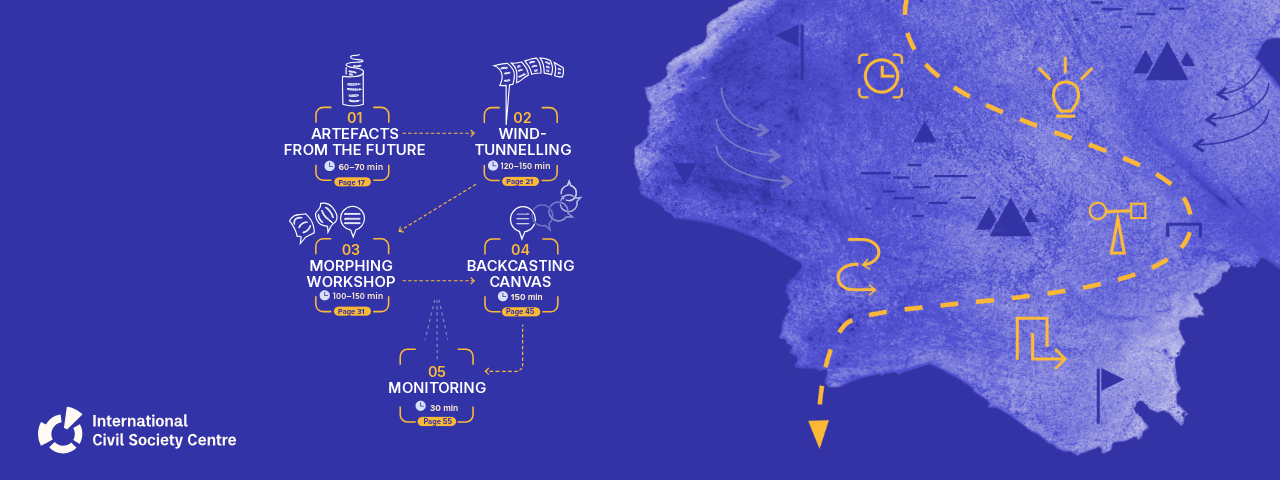
Foresight can support strategy review and adaptation in different ways. Three particularly useful approaches are wind-tunnelling, morphing, and backcasting. Together, they can help organisations move from assessing their existing strategy to adapting it and putting it into action.
Wind-tunnelling: Test the strategy
The term “wind-tunnelling” comes from engineering, where prototypes are tested under different controlled conditions. In a strategy review, the principle is similar: the organisation tests its strategy against a range of possible future scenarios.
The exercise helps identify which elements of the strategy are robust and worth retaining, which are fragile or dependent on certain conditions, which need to be adapted, and which may no longer be relevant. In doing so, wind-tunnelling can quickly expose blind spots.
Morphing: Adapt the strategy
Building on the results of wind-tunnelling, morphing reshapes the strategy by analysing which elements to keep, drop, adapt or add in response to new trends or external factors. Morphing is the point at which the strategy itself begins to change. The process leaves the organisation with a revised strategic framework that combines robust existing elements with adapted and newly introduced priorities.
Backcasting: Move towards action
Once the strategy has been tested and adapted, backcasting can help translate the framework into a realistic pathway for action. It starts by considering what successful implementation of the strategy would look like and then works backwards to identify the milestones, resources, and enabling conditions needed to reach that future.
Working backwards makes it easier to identify dependencies and sequencing. Backcasting helps move the conversation from “Where do we want to go?” to “What needs to happen, and in what order, to get us there?” The result is a pathway connecting the organisation’s long-term ambition to concrete milestones and priority actions.
Foresight is a practice, not a one-off exercise
A one-off exercise cannot make a strategy resilient. Organisations need to monitor changes in their operating environment and consider what these developments mean for their plans.
Regular horizon scanning can help teams identify early signals of change, such as funding shifts, political decisions, changing public attitudes or new technologies. Several related signals may indicate that a more significant shift is emerging.
Organisations can incorporate this practice into existing processes rather than creating an entirely new system. For example, teams could discuss emerging signals during quarterly strategy reviews, leadership meetings or annual planning processes.
We practice a participatory approach with strategic foresight, and with stress-testing strategies, it’s no different. Diverse roles, backgrounds, and lived experiences influence which changes people notice and how they interpret them. A senior leadership team may identify different risks and opportunities than programme staff, communications colleagues, local partners or people working directly with affected communities. Bringing these varied perspectives together produces more than an updated strategy document. It creates stronger organisational alignment and a greater sense of shared ownership.
Ready to stress-test your strategy?
Uncertainty is likely to remain a defining feature of the coming years. Civil society organisations cannot avoid it, but we can become better prepared to navigate it. This requires strategies that can be questioned, tested, and adapted as circumstances change. It also means using moments of disruption as opportunities for learning and transformation.
Our newly published guide “Anticipating Futures: A Guide to Stress-Testing Organisational Strategies in Civil Society” provides a practical process for doing this. It introduces a range of foresight tools, including those outlined above, to help organisations assess the resilience of their existing strategies, adapt them to different possible futures, and translate them into action.
By developing the capacity to anticipate systemic shifts rather than simply reacting to them, organisations can make more informed decisions today and remain effective in the future.
Read the guide here
-
Anticipating Futures: A Guide to Stress-Testing Organisational Strategies in Civil Society
Developed as part of our ‘Anticipating Futures’ initiative, A Guide to Stress-Testing Organisational Strategies in Civil Society helps organisations navigate an increasingly uncertain world. The guide offers a practical framework to explore multiple possible futures, test the resilience of existing strategies and adapt them for long-term impact. Through a series of collaborative exercises, it supports civil society organisations to build strategic resilience, strengthen adaptability and proactively prepare for change.
-
Futures thinking
-
Toolkit
-