It is easy to feel as though the future is arriving faster than organisations can keep up with. Geopolitical shifts, shrinking civic space, rapid advances in artificial intelligence, changing funding models and growing demands for locally led action are all reshaping the environment in which (I)CSOs operate. Yet, despite constant change, many organisations remain trapped in a cycle of responding to immediate challenges, with little time to step back and ask a simple question: Are we preparing for what comes next?
This question sat at the heart of this year’s Futures Thinking Lab, where members of the Scanning the Horizon community came together virtually to explore how (I)CSOs can become better equipped for an uncertain future. One insight surfaced repeatedly throughout the discussions: futures thinking is not about predicting what will happen but about expanding our imagination, questioning our assumptions and making better decisions today.
One of the strongest reminders came from an exercise that asked participants to write letters from a future they wanted to help create. Rebecca Shadwick, Campaigner, Gender Rights and Justice at Oxfam International, introduced Letters from the Future, a foresight and storytelling methodology developed as part of Oxfam’s Personal to Powerful campaign. Inspired by this campaign, participants imagined looking back from a world where civil society had become more collaborative, equitable and resilient. The exercise revealed something important. In our everyday work, it is easy to become consumed by crises, funding deadlines and operational pressures. Creating space to imagine success, rather than simply avoiding failure can fundamentally change how organisations think about strategy. Instead of asking “What is most likely to happen?” participants were encouraged to ask “What kind of future are we working towards?”
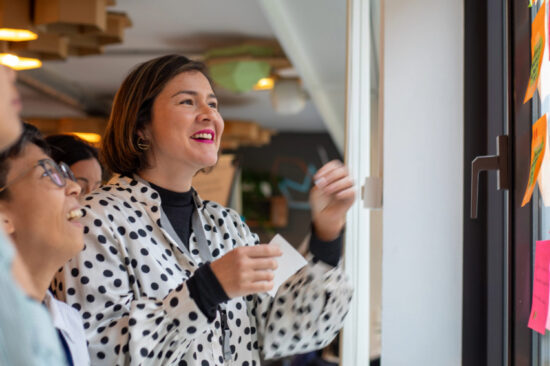
Another recurring theme was the importance of becoming comfortable with uncertainty. Too often, strategy assumes a single future that organisations can plan towards. Whether experimenting with a strategic decision-making game, exploring different futures for localisation or discussing geopolitical change, participants repeatedly questioned assumptions they had long taken for granted. Interactive exercises encouraged participants to test decisions under different conditions, revealing that strategies which appear robust today may quickly lose relevance as circumstances change. The lesson was not that organisations need perfect forecasts, but rather that they need strategies that remain flexible across a range of possible futures.
The most thought-provoking conversations centred on localisation. Rather than treating it simply as a shift in funding or responsibilities, participants explored localisation as a deeper question about power, trust and legitimacy.
What role should ICSOs play in a world where local actors increasingly lead change themselves? How can organisations move beyond supporting localisation to genuinely sharing decision-making and recognising different forms of knowledge and leadership? The discussions suggested that the future relevance of international organisations will depend less on maintaining traditional roles and more on their ability to build equitable partnerships, convene diverse networks and support locally led action.
The Lab also challenged participants to rethink where valuable knowledge comes from. CSOs are often rich in insight. Staff working with communities, local partners and regional offices frequently recognise emerging changes long before they appear in news headlines or formal reports. Yet these perspectives do not always shape organisational decisions.
Building anticipatory organisations, participants concluded, is not simply about collecting more information. It is about creating better connections between the signals organisations already see and the strategic choices they make.
The overriding takeaway from the three days was that futures thinking is no longer a specialist exercise carried out on the sidelines of strategy. In a world defined by uncertainty, it is becoming an essential organisational capability. This does not necessarily require large foresight teams or sophisticated methods. Sometimes it begins with making time to ask different questions, inviting more diverse perspectives into decision-making and creating space to explore possibilities before change becomes unavoidable.
We have launched a Community of Practice for our Scanning the Horizon community, creating a space for members to continue exchanging experiences, practical tools and lessons from their organisations. Becoming more future-ready is not something organisations achieve in a single workshop; it is an ongoing practice of learning, adapting and remaining curious about what lies ahead.
Regularly using futures thinking approaches is not about predicting the future but about creating the conditions to respond to multiple possible futures. This might mean making time to surface signals and perspectives from across the organisation, testing decisions against different scenarios, asking whose knowledge and assumptions shape strategy, or making space to articulate the future the organisation wants to help create. These are relatively simple practices, but together they can strengthen an organisation’s ability to notice change, adapt with intention and act before uncertainty becomes crisis.