Background and Context
Across Africa, a generation of innovators, creators, and problem solvers is utilising technology to address pressing local challenges, from access to education and healthcare to climate resilience and civic engagement. These innovators are reshaping narratives about who leads technological progress and redefining what inclusive innovation looks like on the continent. Yet, while local innovation ecosystems are growing, many innovators face systemic barriers, including limited funding, digital infrastructure gaps, restrictive policies, and challenges to global visibility. At the same time, global technology trends and platforms continue to influence the pace and direction of innovation, often determining which ideas scale and whose voices are amplified.
As Africa’s tech landscape evolves, the question becomes: How do we ensure that local innovations not only thrive within their contexts but also achieve global recognition and impact? How can technology, when guided by inclusion, ethics, and community needs, serve as a bridge between local vision and global influence?
Purpose of the Dialogue
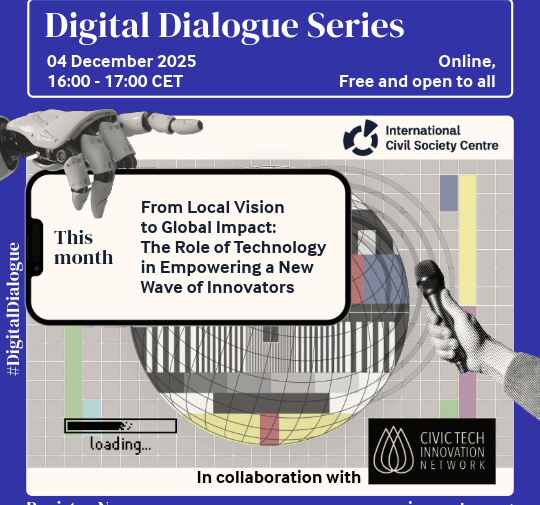
This digital dialogue aims to spotlight how technology can enable locally grounded innovation to achieve global resonance and influence. It will bring together civic technologists, entrepreneurs, researchers, and policymakers to explore:
- The pathways through which local innovators can scale their ideas beyond their communities.
- The role of technology in amplifying local knowledge, creativity, and problem-solving.
- How to foster ecosystems that support innovation grounded in African realities while shaping the global digital future.
By reflecting on the intersection between local vision and global collaboration, the dialogue seeks to celebrate African innovation while addressing the structural barriers that hinder its global recognition and impact.
Key Discussion Areas
1. Technology as an enabler of local innovation: Exploring how digital tools, platforms, and data-driven approaches empower communities to design solutions to their own challenges.
2. Scaling local impact globally: What does it take for locally developed innovations to gain international traction while maintaining their contextual relevance?
3. Bridging ecosystems: How can partnerships between local innovators, policymakers, and global networks unlock new opportunities for collaboration and resource sharing?
4. Inclusion, ethics, and sustainability: Ensuring that technological growth is guided by principles of equity, inclusion, and social impact, not just scalability or profit.